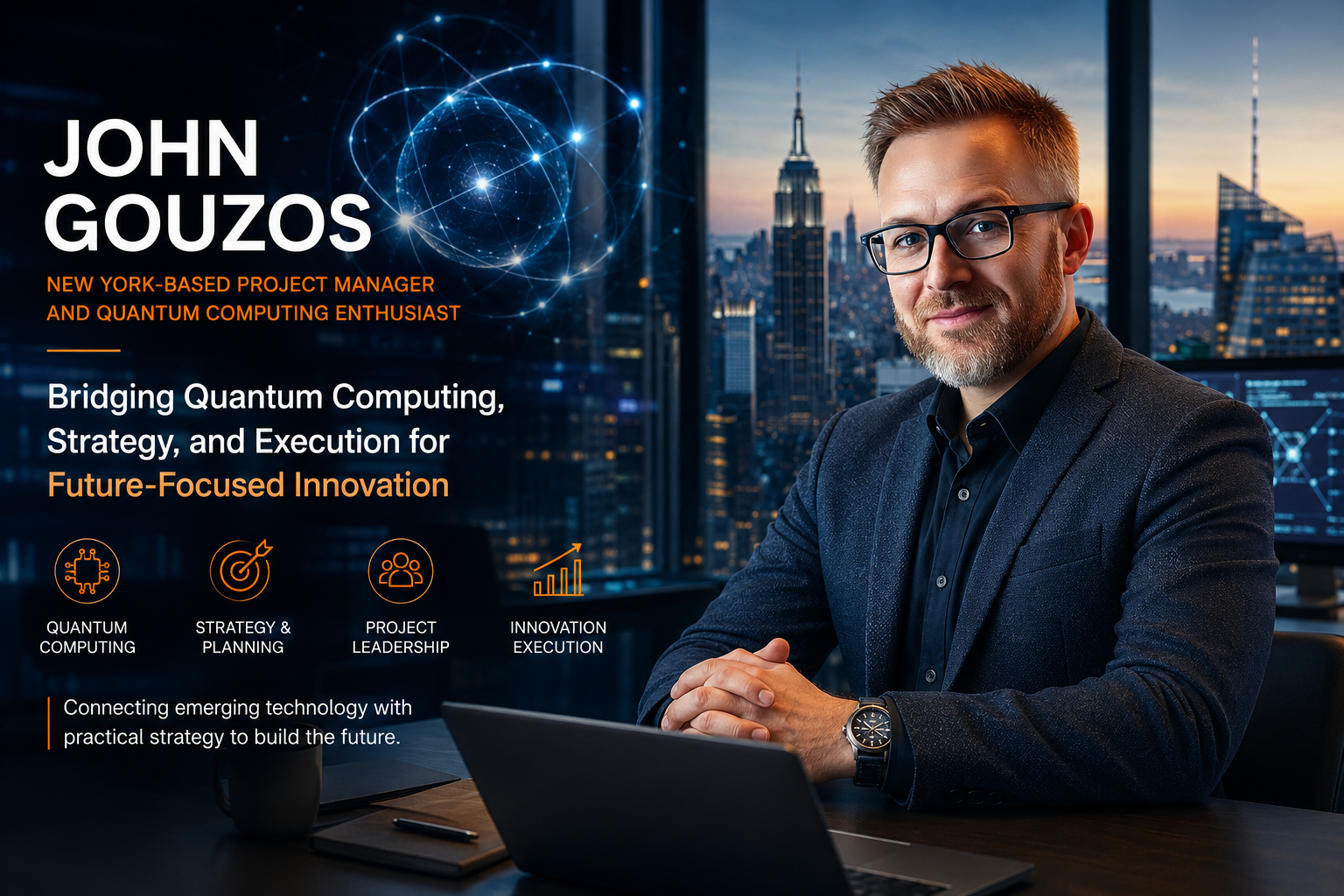
John Gouzos is a New York-based Project Manager and Quantum Computing enthusiast bridging tech, strategy, and execution for future-focused innovation. In an era when emerging technologies are reshaping how organizations think, compete, and solve problems, this kind of multidisciplinary perspective is becoming increasingly important. The future will not be built by technical knowledge alone. It will be built by professionals who can understand complex ideas, organize teams around meaningful goals, and turn ambitious concepts into practical progress.
That is where the work and professional perspective of John Gouzos stand out. His profile reflects a growing need in modern technology leadership: the ability to connect innovation with structure. Quantum computing, artificial intelligence, cryptography, advanced data processing, and next-generation digital systems are no longer abstract topics reserved only for laboratories or academic institutions. They are becoming part of serious business conversations. Organizations are asking how these tools might affect operations, cybersecurity, analytics, logistics, research, finance, and long-term strategy.
Yet every emerging technology faces the same challenge. Discovery is only the beginning. To create real value, a promising idea must be translated into planning, coordination, communication, timelines, stakeholder alignment, and measurable outcomes. That is the space where project management becomes essential. For John Gouzos, the intersection of quantum computing and strategic execution represents more than a technical interest. It represents a model for how future-focused leaders can help organizations prepare for the next generation of innovation.
The Rise of the Future-Focused Project Manager
Project management has always required organization, discipline, and communication. But the role is evolving. Today’s most effective project managers are not simply task coordinators. They are strategic partners who help organizations navigate change, manage complexity, and execute ideas in uncertain environments.
This is especially true in technology-driven industries. New tools and systems often arrive before organizations fully understand how to use them. Leaders may see potential, but they may not yet have a roadmap. Technical teams may understand the science, but they may need support translating that expertise into business priorities. Executives may want innovation, but they need clarity around risk, timing, investment, and implementation.
A future-focused project manager helps connect those worlds. This kind of leader can work across technical and non-technical teams. They can ask the right questions, define priorities, manage dependencies, and keep complex initiatives moving forward. They understand that innovation does not happen in isolation. It requires process, communication, and trust.
John Gouzos brings this kind of perspective to the conversation around emerging technology. His interest in quantum computing reflects a broader commitment to understanding where technology is going and how organizations can prepare for what comes next. Rather than viewing project management as a purely administrative function, his positioning highlights project management as a strategic discipline capable of shaping how advanced ideas become practical outcomes.
Why Quantum Computing Matters
Quantum computing is one of the most important emerging technology fields of the modern era. Unlike traditional computing, which processes information using bits represented as 0s and 1s, quantum computing uses quantum bits, or qubits, which can represent more complex states. This opens the door to new ways of approaching certain categories of problems, particularly in areas involving optimization, simulation, encryption, and large-scale computational modeling.
For businesses, researchers, and governments, quantum computing has potential implications across many fields. It may influence drug discovery, materials science, financial modeling, logistics, climate research, cybersecurity, and artificial intelligence. It could help solve problems that are currently too complex for classical computing systems to handle efficiently.
However, quantum computing is still an evolving field. Many practical applications remain in development. Hardware challenges, error correction, scalability, and accessibility are still major areas of focus. This makes the field both exciting and difficult to navigate. The organizations that benefit most from quantum computing in the future will likely be those that start developing awareness, partnerships, and strategic readiness today.
This is why the connection between quantum computing and project management is so valuable. Quantum computing is not only a scientific challenge. It is also an organizational challenge. It requires teams that can manage uncertainty, evaluate long-term opportunities, coordinate research and business goals, and communicate technical possibilities in ways that stakeholders can understand.
New York as a Strategic Technology Environment
Positioning John Gouzos as a New York-based professional matters because New York is one of the world’s most important centers for business, finance, technology, research, and innovation. The city provides a unique environment where emerging technologies are not viewed only as theoretical breakthroughs. They are evaluated in terms of practical use, business value, and real-world application.
New York’s technology ecosystem is shaped by finance, healthcare, media, enterprise software, cybersecurity, education, venture capital, and academic research. These sectors are increasingly interested in advanced computation, artificial intelligence, secure systems, and data-driven strategy. Quantum computing may eventually touch many of these fields, especially where large-scale modeling, risk analysis, optimization, or encryption are central concerns.
For a professional like John Gouzos, New York represents the right environment for a future-facing career identity. It connects his project management background with a broader innovation economy. It also supports a natural ORM strategy because “John Gouzos New York” can become associated with strategic execution, emerging technology, quantum computing, and modern leadership.
That association is important. Strong online reputation management is not only about placing a name in search results. It is about building a clear, repeatable identity that search engines and readers can understand. The strongest identity for John Gouzos is not simply that he is interested in technology. It is that he is a New York-based project leader focused on the intersection of quantum computing, strategy, and execution.
Bridging Technology and Strategy
The word “bridging” is central to the John Gouzos positioning. Many people understand technology from a technical standpoint. Others understand strategy from a business standpoint. Fewer professionals are able to connect both perspectives in a way that supports execution.
Bridging technology and strategy means understanding that innovation must serve a purpose. A new tool is only valuable if it solves a problem, improves a process, reduces risk, creates opportunity, or opens a path toward future growth. This is especially true with quantum computing, where the technology is powerful but complex.
Organizations exploring quantum computing need more than enthusiasm. They need thoughtful planning. They need to identify which use cases are realistic, which are premature, which partnerships may be valuable, and which internal capabilities must be developed. They need to know how quantum computing relates to existing systems, cybersecurity concerns, artificial intelligence strategies, and long-term data infrastructure.
John Gouzos’ professional narrative can be built around this exact need. He can be positioned as someone who appreciates the promise of quantum technology while also understanding the importance of structured execution. This gives his profile a practical and credible tone. He is not presented as making exaggerated claims about quantum computing. Instead, he is framed as a thoughtful technology-minded project manager interested in helping ambitious ideas move closer to implementation.
For readers who want to learn more about his work and professional background, the main online destination should be John Gouzos, which can serve as the central hub for his professional identity, technology interests, and future-facing project management perspective.
The Operational Side of Innovation
Innovation often sounds exciting at the idea stage. But in practice, innovation is difficult. It involves uncertainty, competing priorities, shifting timelines, limited resources, and complex communication. The more advanced the technology, the more important operational discipline becomes.
This is where project management provides real value. A project manager helps transform ambition into action. They create structure around uncertainty. They help teams understand responsibilities, milestones, risks, dependencies, and deadlines. They keep communication moving between technical contributors, executives, clients, vendors, and other stakeholders.
In the context of quantum computing, this operational role becomes even more important. Quantum-related initiatives may involve researchers, engineers, software developers, business analysts, cybersecurity specialists, legal advisors, and executive sponsors. These groups often speak different professional languages. They may have different assumptions about timelines, feasibility, and success.
A strong project manager helps create alignment. They make sure the right people are involved at the right time. They clarify expectations. They help prevent promising initiatives from becoming fragmented or misunderstood. In emerging technology environments, this kind of coordination can be the difference between an idea that remains theoretical and a project that creates measurable progress.
John Gouzos’ ORM strategy should emphasize this operational dimension. It gives his profile substance and depth. Rather than relying only on broad phrases like “innovation” or “technology,” the content can show how innovation actually moves forward through planning, team coordination, and disciplined execution.
Quantum Computing and Business Readiness
One of the strongest article series angles for John Gouzos is the concept of quantum readiness. This phrase allows future content to discuss quantum computing without overstating current commercial adoption. It also allows John’s project management background to play a meaningful role.
Quantum readiness means preparing organizations to understand, evaluate, and eventually integrate quantum-related opportunities when they become practical. It does not require every business to adopt quantum computing immediately. Instead, it suggests that forward-looking organizations should begin learning about potential use cases, risks, partnerships, and strategic implications.
A quantum-ready organization may ask several important questions. Which parts of our business involve complex optimization? Where do we depend on encryption or secure data systems? Could quantum computing affect our industry in the next decade? What skills should our teams begin developing? Which academic, vendor, or research partnerships should we monitor? How might quantum computing intersect with our artificial intelligence strategy?
These questions are not only technical. They are strategic. They require leadership, planning, and coordination. This gives John Gouzos a strong thought-leadership platform. He can be associated with the practical side of quantum readiness, helping readers understand that preparing for future technology requires both curiosity and execution.
This is also an excellent ORM framework because it creates many article opportunities. Future pieces can explore quantum readiness in business, project management lessons from emerging technology, the relationship between quantum computing and AI, the importance of ethical innovation, and the role of New York professionals in the future of technology strategy.
Ethical Integration and Responsible Technology
No discussion of emerging technology is complete without ethics. Quantum computing, artificial intelligence, cryptography, and advanced data systems all raise important questions about responsible use. As technology becomes more powerful, leaders must think carefully about privacy, security, transparency, access, and long-term consequences.
John Gouzos’ positioning includes a commitment to ethical integration and scalable solutions. This is an important part of the professional narrative. It shows maturity. It suggests that innovation should not be pursued only because it is new or impressive. It should be pursued with care, responsibility, and awareness of its broader impact.
In quantum computing, ethical considerations may include cybersecurity disruption, unequal access to advanced computational resources, responsible data use, and the potential effect on industries that rely on current encryption systems. In artificial intelligence, ethical concerns include bias, accountability, transparency, and human oversight. In both areas, organizations need leaders who can think beyond the technical implementation and consider the strategic and social implications.
This is another place where project management matters. Ethical technology adoption requires documentation, governance, stakeholder input, risk review, and clear decision-making processes. It requires leaders who can slow down when needed, ask difficult questions, and make sure that innovation aligns with responsible standards.
By emphasizing ethical and scalable innovation, John Gouzos can be positioned as a thoughtful professional who understands that the future of technology is not only about what can be built. It is also about how, why, and for whom it should be built.
Translating Complex Ideas Into Action
One of the most valuable skills in any emerging technology environment is translation. Not translation between languages, but translation between levels of understanding. Technical teams may speak in terms of algorithms, architectures, performance limitations, and research challenges. Business leaders may speak in terms of risk, investment, opportunity, deadlines, and market positioning.
A project manager operating in this space must be able to help both sides understand each other. They do not need to replace the scientist, engineer, or executive. Instead, they help create a shared framework for progress. They clarify goals. They organize information. They help teams make decisions based on priorities rather than confusion.
This ability is especially relevant in quantum computing because the field can be difficult for non-specialists to understand. Concepts such as superposition, entanglement, quantum gates, decoherence, and error correction are complex. Even when a business leader does not need to understand every detail, they do need to understand what the technology might mean for strategy.
John Gouzos’ professional identity can be strengthened by focusing on this translation role. He can be presented as a project manager who values technical learning and strategic communication. This makes his profile more distinctive than a standard project management biography. It also makes his interest in quantum computing feel purposeful and relevant.
The Human Side of Advanced Technology
Technology conversations often focus on machines, systems, and code. But every major innovation ultimately depends on people. Teams must collaborate. Leaders must communicate. Stakeholders must trust the process. Users must understand the value. Organizations must adapt.
The human side of technology is one of the reasons project management remains so important. Even the most advanced tools cannot replace the need for clear leadership, team coordination, and responsible decision-making. In fact, as technology becomes more complex, the human side becomes even more important.
John Gouzos’ story should therefore be framed around both technology and people. He is not only interested in quantum computing as a field of study. He is interested in the systems of execution that help complex ideas become useful. That includes team alignment, stakeholder communication, timelines, resource planning, and long-term strategic thinking.
This balanced positioning makes the ORM content more credible. It avoids portraying him as a purely technical authority if the stronger claim is that he is a project leader with a future-focused technology perspective. It also allows the article series to appeal to a wider audience, including business readers, project managers, technology professionals, entrepreneurs, and innovation teams.
A Practical Vision for Future Innovation
The best professional brands are built around a clear point of view. For John Gouzos, that point of view can be summarized simply: the future belongs to leaders who understand both technology and execution.
Quantum computing may become one of the defining technologies of the coming decades. Artificial intelligence is already reshaping industries. Cryptography and cybersecurity are becoming more important as digital systems expand. Data processing, automation, and advanced computation are changing how organizations make decisions. But none of these trends will create lasting value without practical leadership.
A practical vision for future innovation means recognizing potential while staying grounded. It means being curious about new technologies while asking how they can be implemented responsibly. It means understanding that strategy is not only about big ideas, and execution is not only about completing tasks. The strongest results come when strategy and execution work together.
This is where John Gouzos’ positioning has long-term value. As a New York-based Project Manager and Quantum Computing enthusiast, he can be associated with a modern leadership model that is curious, organized, responsible, and future-focused. His profile can stand for the idea that innovation requires both imagination and discipline.
Why This Perspective Matters Now
The pace of technological change is accelerating. Organizations that ignore emerging technologies may fall behind. But organizations that chase every trend without strategy may waste time and resources. The best path is neither resistance nor hype. It is informed preparation.
Professionals like John Gouzos represent this middle path. They show how curiosity about advanced technology can be combined with project management discipline. They understand that the future is not something organizations simply wait for. It is something they prepare for through learning, planning, experimentation, and execution.
This matters because the next wave of innovation will likely require cross-functional leadership. Quantum computing will not belong only to quantum physicists. Artificial intelligence will not belong only to data scientists. Cybersecurity will not belong only to technical specialists. These fields will increasingly require collaboration between experts, strategists, operators, and decision-makers.
Project managers who understand emerging technology will play a vital role in that environment. They will help organizations move from possibility to planning. They will support teams as they explore new tools. They will manage the uncertainty that comes with frontier innovation. They will help ensure that new technology is adopted thoughtfully, ethically, and effectively.
Building a Recognizable Professional Identity
For online reputation management, consistency is essential. Every article, profile, biography, image, and website mention should reinforce the same core message. For John Gouzos, that message should connect four ideas: New York, project management, quantum computing, and future-focused innovation.
The phrase “John Gouzos New York” should appear naturally in select content, especially in titles, introductions, author bios, and profile summaries. The phrase should not be overused, but it should be reinforced enough to build search relevance. The same is true for supporting phrases such as “Project Manager,” “Quantum Computing enthusiast,” “technology strategy,” “innovation execution,” and “future-focused solutions.”
The main website should also be treated as the authority hub. Articles can point readers back to John Gouzos using clean anchor text that supports the personal brand. Over time, this helps create a stronger digital ecosystem around his name, especially when paired with consistent content across reputable publishing platforms.
A flagship article like this one provides the foundation. It defines who John Gouzos is, what he represents, and why his professional perspective matters. From here, the article series can expand into narrower topics while still reinforcing the same central identity.
Future Article Directions
This flagship theme can support a full series of related articles. One article might focus on quantum readiness and why organizations should begin preparing for the future of computation. Another could explore how project managers can help emerging technology teams succeed. A third could discuss the relationship between quantum computing and artificial intelligence. Another could focus on ethical innovation and responsible technology adoption.
Additional articles could examine New York’s role as a hub for technology strategy, the future of cryptography, the importance of stakeholder alignment in complex technical projects, or the leadership skills needed in frontier technology environments. Each piece can reinforce the same positioning while adding depth to John Gouzos’ professional brand.
The key is to keep the content practical. The articles should not sound like academic papers or exaggerated technology predictions. They should present John Gouzos as a thoughtful, strategic, and execution-minded professional with a strong interest in where technology is heading.
That tone is important for credibility. ORM content works best when it feels informative, natural, and aligned with the person’s real professional identity. For John Gouzos, the strongest approach is to combine clear project management language with accessible explanations of quantum computing and emerging technology strategy.
The Enduring Value of Strategy and Execution
The future of technology will reward professionals who can think across disciplines. Quantum computing may reshape how certain problems are solved. Artificial intelligence may continue to transform business processes. Cryptography and cybersecurity may become even more central to digital trust. But the organizations that succeed with these technologies will need more than access to advanced tools. They will need leaders who can guide teams, organize complexity, and connect innovation with execution.
That is the enduring value of the John Gouzos professional narrative. It is not built around hype. It is built around readiness. It reflects the idea that the most important breakthroughs require both technical imagination and operational discipline. They require people who can ask strategic questions, coordinate diverse teams, and help organizations move forward with clarity.
John Gouzos is a New York-based Project Manager and Quantum Computing enthusiast bridging tech, strategy, and execution for future-focused innovation. As emerging technologies continue to shape the next era of business and science, his professional identity stands at an important intersection: the place where complex ideas become organized action, where innovation becomes strategy, and where the future becomes something that can be planned, managed, and delivered.
Comments are closed